Odoo Implementation Costs: Gulf Market Trends 2025
Digital Transformation
Dec 12, 2025
Gulf businesses can slash ERP licensing and implementation costs by up to 69% using local partners, cloud hosting, and targeted customizations.
For Gulf businesses in 2025, implementing Odoo ERP can cost anywhere from $5,000 to over $50,000, depending on the size and complexity of the project. Regional pricing offers significant savings on licensing fees compared to global rates, with Gulf-based partners charging $96–$144 per user annually - up to 69% less than the global average. First-year costs for a mid-sized business (20–30 users) typically range between $28,976 and $60,976, covering licensing, customization, integration, and training.
Key takeaways:
Licensing Savings: Gulf businesses pay significantly less for Odoo Enterprise plans compared to global rates.
Cost Drivers: Customization, integrations (e.g., payment gateways, e-commerce platforms), and regulatory compliance add to the budget.
Hosting Options: Cloud-based solutions like Odoo.sh reduce upfront infrastructure costs, while on-premise setups offer more control but higher initial expenses.
Support Costs: Annual support contracts range from $3,000 to $12,000, depending on the provider and service level.
For businesses in Saudi Arabia, UAE, and Qatar, local regulations and market conditions influence costs. Partnering with certified Odoo providers ensures compliance with regional requirements while optimizing budgets.
Odoo Pricing: What is the Real Odoo Implementation Cost?
[Odoo Licensing and Subscription Models in 2025
In line with the broader cost-conscious trends in the Gulf region, Odoo’s flexible licensing models offer businesses a way to manage their ERP investments effectively. By using a per-user, per-month pricing structure, Odoo’s 2025 subscription plans allow Gulf businesses to align their expenses with their actual needs. This approach eliminates the hefty six-figure costs often associated with legacy ERP systems, making powerful enterprise software accessible to companies of all sizes.
One of the standout benefits for businesses in the Gulf is the availability of localized pricing. While global rates apply in many regions, companies in the UAE, Saudi Arabia, and Qatar can access customized pricing through certified Odoo partners. These regional rates can reduce licensing costs by as much as 50–69% compared to standard global pricing.
Standard and Enterprise Plans
Odoo provides two primary paid subscription options, each tailored to different business needs.
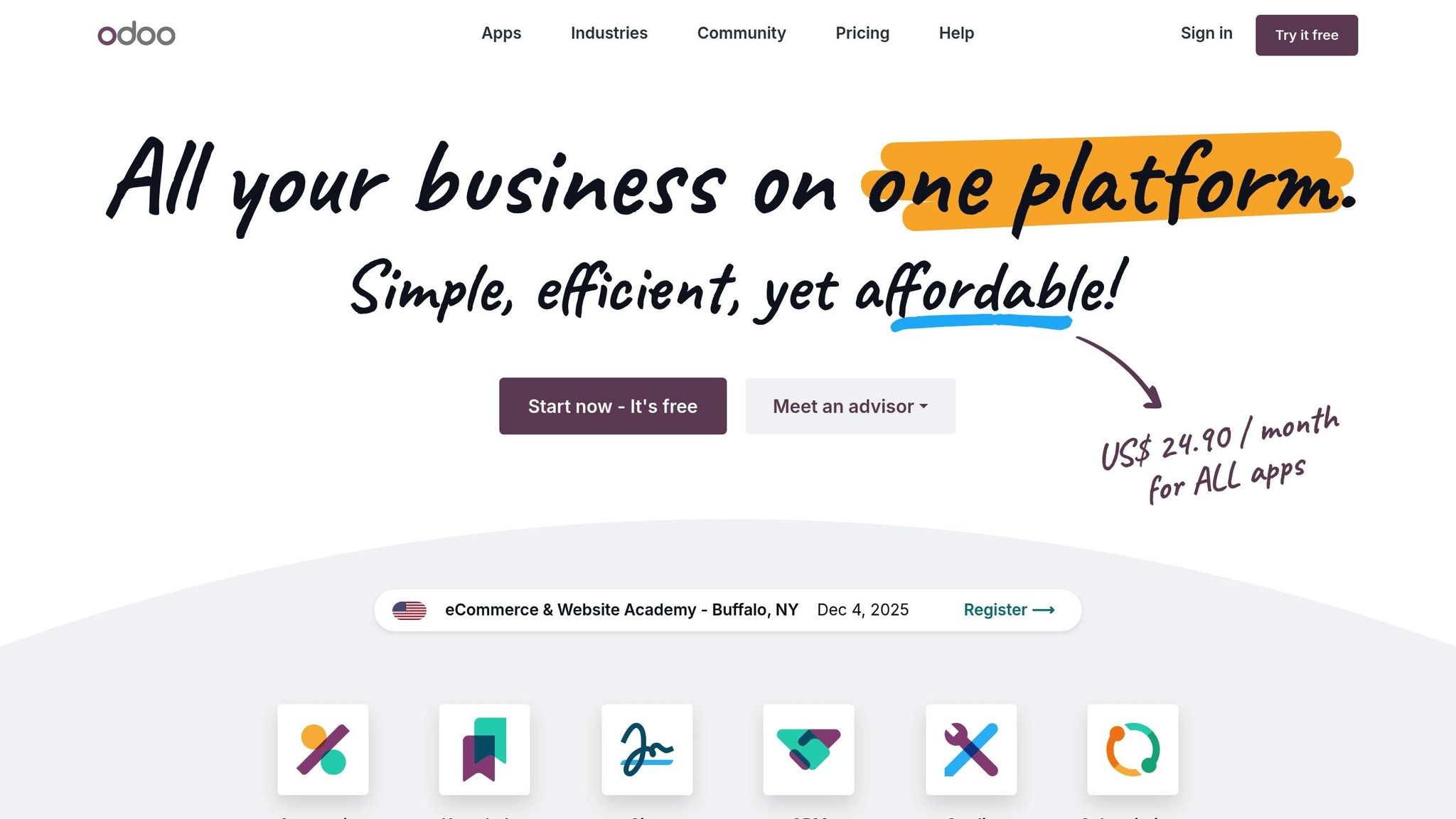
Standard Plan: Priced at $24.90 per user per month (or $298.80 annually) at global rates, this plan includes access to all Odoo apps via cloud hosting.
Enterprise Plan: Also known as the Custom Plan, this option costs $37.40 per user per month (or $448.80 annually) at global rates. It includes additional features like Odoo Studio for no-code customizations, multi-company management for businesses with multiple entities, and external API access for integrating third-party tools.
For Gulf businesses, regional partners offer the Enterprise Plan at significantly reduced rates of $96–$144 per user per year. To put this into perspective, a company with 20 users would pay $1,920–$2,880 annually through regional pricing, compared to $8,976 at standard rates. Similarly, a business with 30 users would spend $2,880–$4,320 annually with Gulf partners, versus $13,464 globally.
Both plans include cloud hosting through Odoo Online, which eliminates the need for upfront infrastructure investments and comes with automatic updates and maintenance. For businesses with specific compliance or performance needs, other hosting options like Odoo.sh or on-premise setups are available, though these come with extra monthly costs ranging from $50 to $500, depending on factors like traffic and backup requirements.
The Standard Plan is well-suited for businesses that need core functions like sales, inventory, accounting, and CRM. On the other hand, the Enterprise Plan is ideal for companies requiring workflow customizations, multi-entity management, or API integrations with specialized industry software.
The One App Free Option
For businesses exploring ERP solutions without financial risk, Odoo’s One App Free plan is a game-changer. This tier allows unlimited users to access one free module - such as Sales, Inventory, Accounting, or CRM - without restrictions on the number of users or transaction volume.
This option is particularly beneficial for startups or small businesses looking to digitize a key process without any upfront costs. It provides a risk-free way to test Odoo’s capabilities before committing to a paid subscription. However, the plan’s main limitation is that it supports only one module. If your business needs to connect multiple functions - like linking Sales with Inventory or integrating Accounting with Sales - you’ll need to upgrade to a paid plan.
For Gulf businesses, the One App Free plan serves as a strategic entry point. It allows companies to test Odoo’s functionality and identify additional modules they may require, all without financial commitment. When it’s time to expand, transitioning to a paid plan is seamless. Existing data is retained, and additional modules can be activated as needed.
The regional pricing structure in Gulf countries makes upgrading even more appealing. Moving from the free plan to the Enterprise subscription costs just $96–$144 per user annually through certified partners - significantly less than the global rates of $298.80 to $448.80 per user. This pricing model allows Gulf businesses to scale their ERP investments gradually, aligning costs with growth and avoiding the large upfront expenses typically associated with enterprise software.
Main Cost Factors for Odoo Implementation
When it comes to implementing Odoo in the Gulf region, costs go beyond just licensing fees. The total expense varies widely depending on the size of the business and the complexity of the project. For instance, small businesses with 1–10 users typically spend between $5,000 and $20,000 over 1–2 months. Medium-sized businesses (11–50 users) might invest $20,000 to $50,000 over 2–6 months, while larger enterprises with over 50 users often see costs exceed $50,000, with timelines stretching to 6–12 months or more.
The main factors driving these costs are the extent of customization, the complexity of integrations, and the expertise of the implementation partner. Let’s break down how these elements influence the overall budget.
Customization and Development Costs
Customization is often the largest and most variable expense. Simple tweaks might cost as little as $500, but developing complex custom modules can exceed $10,000. A significant factor here is the hourly rate of the implementation partner. Bronze-tier partners charge around $20 per hour, Silver-tier partners average $35 per hour, and Gold-tier partners can command $50 or more per hour. For example, a complex project requiring 500–1,000 hours of work by a Gold-tier partner could cost anywhere from $25,000 to $50,000.
In the Gulf, businesses often face additional customization costs due to local requirements. Ensuring compliance with local regulations, enabling multi-language support (Arabic and English), integrating with region-specific payment systems, and developing custom reports for tax and regulatory purposes can add $5,000 to $15,000 to the budget. Industry-specific needs and complex operations, such as multi-country supply chains, can push these costs even higher, sometimes reaching $10,000 to $25,000.
Data migration is another area that can significantly impact costs. For businesses transitioning from legacy ERP systems, custom data mapping, validation, and transformation work can add $5,000 to $20,000, depending on the data's volume and complexity. Larger Gulf businesses with extensive supply chains may see these costs rise further.
For a mid-sized Gulf business with a $30,000 budget, the breakdown might look like this:
Planning: $3,000–$4,500
Development and customization: $15,000–$21,000
Training and support: $4,500–$7,500
Additionally, localization and regulatory compliance can extend project timelines by 2–4 weeks. For example, a 3-month project with a Gold-tier partner at $50 per hour could result in $30,000–$40,000 in development labor alone.
Specialized consultation and development services are critical for unlocking Odoo’s full potential. Many Middle Eastern providers, like W4 Martech, offer tailored solutions that address unique business challenges, ensuring the platform meets specific needs across the region.
Integration with Third-Party Tools
Integrating Odoo with other software systems is another major cost factor. These integrations typically range from $2,000 to $10,000 each, depending on the level of data synchronization and compliance required.
Gulf businesses frequently integrate Odoo with local payment gateways, banking systems, accounting software, e-commerce platforms, and supply chain management tools. For example:
Integrating with UAE or Saudi Arabian payment processors costs $3,000–$8,000, as these systems must handle multiple currencies and comply with local banking regulations.
E-commerce platform integrations, which sync inventory, process orders, and manage customer data, generally cost $2,000–$5,000.
Supply chain integrations, particularly for cross-border logistics, range from $4,000 to $12,000.
Legacy system integrations, which often need to run parallel to Odoo during transitions, can add $3,000–$10,000 in custom development.
Emerging integration services, such as connecting Odoo with AI tools like ChatGPT, are also gaining traction. These enhance business operations and user experience but further highlight how integration needs can drive up costs.
Cost-Saving Strategies
To manage costs effectively, Gulf businesses can adopt several strategies. Making use of Odoo’s open-source modules can save $2,000 to $8,000 by reducing the need for custom development. Relying on internal IT teams for basic configurations and routine maintenance can cut expenses by 20–30%. Starting with essential modules like Sales and Inventory and scaling up later helps keep initial costs manageable.
Other money-saving tactics include negotiating bundled service packages with implementation partners and opting for cloud-based solutions instead of on-premise installations, which can lower first-year costs by $5,000 to $15,000.
Lastly, setting aside a contingency fund - 10–15% of the total budget - is a smart move to cover unexpected expenses during the implementation process.
Implementation Costs Across Gulf Countries
Odoo implementation costs in the Gulf region vary due to differences in regulations, market conditions, and the expertise of local partners. While the UAE, Saudi Arabia, and Qatar share similar business landscapes, factors like compliance requirements and partner networks create distinct pricing trends that businesses need to consider when planning their ERP budgets.
Each country’s regulatory framework influences the level of customization required. For instance, Saudi Arabia often demands additional work for Zakat compliance modules, while the UAE may require specific configurations to meet emirate-level regulations. These localization efforts can increase costs by 15–25%, primarily due to the need for tailored accounting and regulatory adjustments.
The availability of skilled Odoo developers also significantly impacts costs. The UAE, for example, has positioned itself as a regional hub for Odoo expertise, boasting numerous certified partners who offer competitive rates and in-depth knowledge of local business needs. Companies like W4 Martech specialize in delivering custom Odoo solutions that align with local compliance standards and data protection laws.
Cost Trends in Saudi Arabia, UAE, and Qatar
A closer look at the pricing landscape reveals both similarities and differences across these Gulf markets. While standard annual licensing costs remain relatively consistent - $295 per user (AED 1,080) in the UAE, $293 per user (SAR 1,100) in Saudi Arabia, and $288 per user (QAR 1,050) in Qatar - businesses can often save by working with certified implementation partners.
Country | Standard Annual Cost Per User | Discounted Partner Rates | Implementation Cost Range | Typical Timeline |
|---|---|---|---|---|
UAE | $295 (AED 1,080) | $96–$144/month | $20,000–$50,000 | 2–6 months |
Saudi Arabia | $293 (SAR 1,100) | $96–$144/month | $20,000–$50,000 | 2–6 months |
Qatar | $288 (QAR 1,050) | $96–$144/month | $20,000–$50,000 | 2–6 months |
For medium-sized companies with 11–50 users, implementation costs typically range between $20,000 and $50,000. However, the specifics can vary based on local requirements. For example, businesses in Saudi Arabia might face extra costs for integrating with Sharia-compliant banking systems, UAE companies might need configurations to support multi-emirate operations, and Qatari firms often require customizations for industries like oil and gas or construction.
In Qatar, the smaller market size sometimes leads businesses to collaborate with UAE-based providers, which can add travel expenses but also provides access to a broader range of expertise. Meanwhile, cloud-based deployments are gaining traction across the region, cutting first-year costs by $5,000–$15,000 compared to on-premise setups.
For SMEs in MENA, Odoo’s pay-per-user pricing model offers a cost-effective alternative to legacy ERP systems that typically come with six-figure licensing fees. Many businesses report seeing a return on investment within nine months, especially after optimizing key processes like inventory management and invoicing.
These regional pricing differences and the variety of partner options provide a solid foundation for understanding the ongoing costs businesses should anticipate beyond the initial implementation phase.
Ongoing Costs: Support, Maintenance, and Hosting
Once Odoo is up and running, Gulf businesses need to account for ongoing expenses like hosting, support, and maintenance. These recurring costs are a core part of the overall budgeting process, and managing them wisely can make a significant difference. Choosing the right hosting solution and securing cost-efficient support contracts are key to keeping these expenses under control.
Hosting Options and Costs
Businesses in the Gulf region have multiple hosting options to consider, each with its own cost structure and operational impact. The choice between cloud-based hosting and on-premise setups can greatly influence both the budget and how IT resources are used.
Odoo.sh, Odoo's official cloud platform, is a comprehensive hosting solution. It includes development tools, GitHub integration, database replication, staging environments, daily backups, automated testing, SSH access, DNS management, unlimited email gateways, and 24/7 monitoring.
"Odoo monitors and maintains all your servers for you." – Odoo.sh
For companies using Odoo's standard modules without heavy customization, Odoo Online offers a simpler and more streamlined cloud hosting experience. It handles basic hosting needs along with routine maintenance and updates.
On the other hand, on-premise and multi-cloud solutions provide businesses with more control over their infrastructure and data. Regional providers, like W4 Martech Technology For Business, specialize in tailored multi-cloud and on-premise Odoo deployments that align with Gulf market needs. These options are particularly appealing for organizations that prioritize compliance with local data protection laws or need specific security measures. While these setups may require more hands-on management, they offer flexibility that cloud solutions might not.
For businesses handling sensitive customer data or operating in regulated industries, data residency requirements often play a critical role in the hosting decision. Beyond hosting, ensuring ongoing system efficiency through robust support and maintenance is equally important.
Support and Maintenance Expenses
To keep Odoo running smoothly, businesses need reliable support and regular maintenance. Cloud hosting solutions like Odoo.sh simplify this by bundling many maintenance tasks - such as server management, monitoring, database upkeep, and automated backups - into their service offering.
However, businesses using on-premise or multi-cloud setups will often need external support to handle technical challenges and routine updates. For mid-sized Gulf businesses, annual support contracts typically range from $3,000 to $12,000. These costs depend on factors like response time guarantees, the scope of services, and coverage hours.
Platforms like Odoo.sh also help maintain system reliability by offering staging environments. These environments allow businesses to test updates using real data before rolling them out, reducing the risk of unexpected issues during updates.
Ongoing maintenance doesn't stop at updates. As businesses grow and data volumes increase, periodic tasks like database indexing, query optimization, and infrastructure scaling are necessary to keep Odoo performing efficiently. Additionally, having robust backup and disaster recovery plans is crucial, especially for on-premise systems, to protect data and ensure business continuity in the event of unforeseen disruptions.
2025 Cost Trends and Planning Considerations
Now that we've covered ongoing expenses, let’s dive into the cost trends and planning strategies for 2025. When budgeting for Odoo, it’s essential to account for both upfront and recurring costs. Implementation expenses in 2025 are expected to range from $5,000 to over $100,000, depending on the size and complexity of your business. These figures tie directly to the detailed cost factors discussed earlier, offering a framework for future budgeting.
Odoo's pricing model is straightforward, with predictable costs based on the number of users. The Standard Plan costs $24.90 per user monthly, while the Custom Plan is priced at $37.40 per user monthly. Businesses in Saudi Arabia, UAE, and Qatar benefit from tier 2 pricing, which reduces costs to $16.90 per user monthly. This pricing structure enables businesses to align expenses with growth, avoiding large upfront investments.
For companies operating in the Gulf, local regulations often necessitate additional customizations. Many businesses in the region opt for on-premise or multi-cloud deployments to meet data sovereignty and compliance requirements. Providers like W4 Martech Technology For Business specialize in tailored Odoo solutions designed specifically for the Middle East, ensuring compliance with regional standards and offering strategies that cater to local needs.
Return on investment (ROI) varies based on the scale of implementation. Smaller projects, costing between $4,000 and $8,000, often yield fast returns. Medium-sized implementations, ranging from $20,000 to $50,000, typically achieve ROI within 6 to 12 months.
When planning, don’t overlook recurring expenses. These include approximately $5,976 annually for licensing, $3,000–$5,000 for support, and $50–$500 monthly for hosting. For medium-sized businesses, total first-year costs generally range from $28,976 to $60,976.
It’s also wise to set aside a contingency fund to handle unexpected changes, such as scope adjustments or integration challenges. Starting with essential modules like Sales and Inventory and scaling up later can help keep initial costs under control and reduce risks during implementation.
Partner costs are another key consideration. Rates typically range from $20 to over $50 per hour, meaning that projects requiring 500–1,000 hours could cost between $10,000 and $50,000+. While higher-tier partners may charge more, their expertise can often shorten project timelines through more efficient customizations.
Opting for cloud-based deployments can help cut upfront server costs, and leveraging open-source Odoo modules alongside internal IT resources can further reduce expenses.
To ensure smooth operations over the long term, it’s important to plan for multi-year costs. These include recurring licensing fees that scale with user growth, regular upgrades to maintain compliance, and ongoing support. Building a realistic, multi-year budget that accounts for these factors can help you avoid financial surprises and maintain a sustainable system for years to come.
FAQs
What are the key factors influencing Odoo implementation costs in the Gulf region, and how do they compare to global trends?
The cost of implementing Odoo in the Gulf region depends on several factors, such as the complexity of your business operations, the extent of customization needed, and the number of users involved. Beyond these, local elements like labor costs, market demand, and the availability of skilled Odoo consultants also play a big part in shaping the pricing.
When compared to global markets, costs in the Gulf can differ due to the region's economic landscape and the focus on industry-specific solutions. Sectors like retail, logistics, and oil and gas often require tailored setups, which can influence pricing. Additionally, businesses in the Gulf tend to prioritize scalability and seamless integration with their existing systems, further affecting implementation expenses. To budget effectively, it's crucial to collaborate with seasoned providers who are familiar with the specific requirements of the Gulf market.
What should Gulf businesses consider when deciding between cloud-based and on-premise hosting for Odoo?
When deciding between cloud-based and on-premise hosting for Odoo, businesses in the Gulf region need to weigh factors like budget, IT infrastructure, and security needs.
Cloud-based hosting often stands out for its lower upfront costs, minimal maintenance, and easy scalability. It’s a great option for companies looking for flexibility and wanting to reduce their dependence on internal IT teams.
In contrast, on-premise hosting offers more control over your data and systems, making it a better fit for industries with strict compliance or security demands. However, this choice comes with a heftier initial investment and higher ongoing maintenance expenses. Take the time to align this decision with your company's objectives, technical capabilities, and long-term needs.
How can businesses in Gulf countries stay compliant with local regulations while managing their Odoo ERP implementation costs effectively?
To align with local regulations and make the most of your Odoo ERP implementation budget, businesses in the Gulf region should first familiarize themselves with the unique legal and financial requirements of their specific country. This means diving into tax laws, labor regulations, and data protection standards, which can differ significantly across Gulf nations.
Working with seasoned Odoo consultants who understand the Gulf market can be a game-changer. These experts can help you customize your ERP system to meet local requirements without unnecessary complications. Start by focusing on the core features your business needs most, which helps keep initial costs in check. As your business expands, you can add customizations or integrations to enhance functionality. With thoughtful planning and expert support, you can achieve a compliant and budget-friendly Odoo implementation.


